
Although the Danna Brothers’ Pixar score ranks behind those
from Michael Giacchino and Thomas Newman as well as Randy Newman’s better
efforts, it still aptly accentuates the breathtaking landscapes and
straightforward relationships of the film. While the quantity of themes is
impressive—the score features tunes for Arlo, Arlo’s home, Arlo’s family, Spot,
and the T-Rexes—many of them sound just a little too similar. The family theme, first heard in “Make Your
Mark,” imparts nobility with its reverent chords, while “Run with the Herd”
features galloping statements of the T-Rex-theme, the home theme, and Arlo’s
theme. The Dannas’ characteristic use of exotic instrumental colors adds zest
to the harmonically pleasing tunes, even if the effect fails to reach the
admittedly lofty heights that Thomas Newman periodically reaches using similar
musical ingredients. Perhaps the score’s only crime is not being as spectacular
or memorable as other similar scores; it’s certainly pleasant with a
well-structured dramatic arc.
(The Good Dinosaur Film Review)
(The Good Dinosaur Film Review)
19. Disneynature:
Monkey Kingdom (Harry Gregson-Williams)


Gregson-Williams in electronic thriller mode is hit (Spy
Game) or miss (The Number 23), but his orchestral scores almost always evince
the composer’s command of melody and color. Exotic, ethereal voices and frisky,
frolicsome rhythms abound in this score—sometimes in the same cue (“A Magical
Kingdom”). “Maya” introduces a winsome little tune on pan flute—amidst all of
the Tony Scott scores, one can forget that HGW is so good at writing these
softer, appealing themes. “Top of the Trees” starts a pleasant groove—the
delicate flute flourishes are a particularly nice touch. There’s an unexpected
but lovely waltz in “The Lily Pond,” while “Termites” and “Retaking the Rock”
boast lush strings fit for long shots of some natural vista. The latter cue
features a touch of action as well, though it’s not top-tier Gregson-Williams
material. As the adjectives in this long-winded paragraph reveal, this is a
feel-good score, but it doesn’t have any truly spectacular moments or strong
melodies.
18. Bridge of Spies
(Thomas Newman)


Faced with the unenviable position of filling in for John
Williams, Thomas Newman more than acquitted himself with his dignified music
for this lauded Spielberg film. While Newman doesn’t abandon most of the
elements that constitute his musical voice—the vivid instrumentation, prickly
rhythmic ostinatos, and passages of tranquil harmonic bliss—he molds these
elements into a more classically dramatic approach in the best Williams
tradition. Resonant Russian choral tunes and a sincere, almost ballad-like main
theme form the staunch foundation for the score, culminating in the impressive
trifecta of “Glienicke Bridge,” “Homecoming,” and “End Credits” (which also
make up more than half of the score’s running time). The first cue in this trio
offers a master class on how to steadily build suspense without relying on dull
drones or humdrum percussion patterns, the second explores heartfelt Americana,
and the end credits showcase Newman’s invigorating choral writing. The first
half of the score remains rather restrained, but I suppose that’s only
reflecting the nature of the film itself.
17. The Hunt (Steven
Price)


Although I wasn’t the biggest fan or Price’s Gravity, he did
establish a distinct voice. The Hunt takes the most appealing aspects of
Price’s musical style and spreads them out over 2.5 hours of mostly standalone
cues, each one aurally portraying different species or aspects of the natural
kingdom. Price starts the album with the best cue right off the bat—“A Game of
Strategy” features an energizing anthem at once lyrical and heroic, reminiscent
of Gravity’s penultimate cue. Price’s signature electronic manipulations of the
orchestra don’t grate as they did in Gravity, but instead galvanize the theme,
the sounds meshing with the counters of the melody organically. “The Blue
Whale” is another highlight, orchestra and choir moving from ethereal wonder to
almost transcendent majesty; string patterns play off each other, adding to the
music’s kinetic energy. However, aside from five or six other cues, much of the
rest of the lengthy score, while competent, fails to approach the stirring vibrancy
of these two highlights.
16. Fifty Shades of
Grey (Danny Elfman)


Given the movie’s sensationally lurid subject matter, Elfman
wisely decided not to get too kinky with the music and risk camping up the
images. (Or maybe they were still campy; I’m certainly not about to watch the
film to find out.) A more lush variation on his recent documentary scores, the
score relies on patterns, textures, and motifs rather than on overt, hummable
themes. “Shades of Grey” sets the tone with bubbling electronics, sighing
flute, and Elfman’s characteristically skittering strings. “The Red Room” finds
Elfman getting a little funky with the electronics, recalling his music for
Dead Presidents and the main titles for To Die For. Electric guitar creates an
atmosphere of slowly simmering preparation and release in “Ana and Christian”
(similar to the finale of The Kingdom), while voices denote sensual ecstasy in
“Counting to Six” (and reaching ironically angelic heights in the non-Elfman
composed “Bliss”). Elfman threads the conclusive “Variations on a Shade” (the
best track) with an almost pop-ish beat on drum kit and electronics, orchestra
churning under aspiring parallel notes from violins and bass guitar. The lack
of a strong melody is a bit of a shame, but Elfman, as is his wont, still
creates appealing music with just a touch (in this case) of cheekiness.
15. Jurassic World
(Michael Giacchino)


Although this score shows that Giacchino isn’t quite John
Williams’s successor, it does offer further proof that he is one of the most
talented composers working today. After a welcome arrangement of Williams’s fantastic
Jurassic Park theme (“Welcome to Jurassic World”), Giacchino mostly sticks to
his own material, with snatches of Williams’s “island” fanfare and even the
Lost World theme adding a kick to the proceedings. Giacchino shrewdly writes
his new themes so they reflect the tone of Williams’s themes. The Indominus Rex
theme’s low horns echo the ominous cast of the Velociraptor theme; the delicate
family theme recalls the sparkling, childlike lullaby of “Remembering Petticoat
Lane;” and the resplendent Jurassic World melody effortlessly flows into
Williams’s Jurassic Park theme in “Nine to Survival Job.” However, it’s best
not to compare the score to Williams’s near-peerless original as you’ll
admittedly come away disappointed. Giacchino’s action material isn’t quite up
to his usual standards, relying more on staid repetition of short musical
fragments. Despite this minor reservation, choice moments, such as the brutal
choral chanting in “Our Rex Is Bigger Than Yours” inject ample thrills, while
Giacchino applies and develops his new themes—the arrogant, militaristic melody
for InGen is particularly admirable—with remarkable aplomb.
14. The Hunger Games:
Mockingjay Part 2 (James Newton Howard)


From the first to the third entry in Cookie Monster’s
favorite franchise, James Newton Howard’s scores have gotten better, even if
they haven’t quite reached the apex of his capabilities. The final entry
continues the trend by being slightly better than its immediate predecessor,
featuring the most sustained, thrilling, and rich action cues in the series. It’s
not all blood and thunder, with “Your Favorite Color Is Green” developing a
folk melody into a liturgical hymn and a spoiler-titled track pushing a solo
female vocal into near-operatic peaks. The two “Attack” cues (Sewer and Rebels)
surge with dynamic syncopated ostinatos, sumptuous fanfares worthy of the
composer’s Disney scores, and staccato choir outbursts—a far cry from the
stripped down action cues in the first Hunger Games. To cap off the series,
Howard sends off Rue’s heartbreaking theme with a gorgeous threnody followed by
cascading waves of strings joined by triumphant brass and choir. The score is
still far from Howard’s best, but he did manage to gradually introduce the lush
compositional mannerisms that made so many (like me) fall in love with his
music.
13. Pixels (Henry
Jackman)


While not as John Williams-esque as Jackman proclaimed in
various interviews, Pixels still mostly eschews the 8-bit video arcade palette
the composer had so adroitly employed in Wreck-It Ralph in favor of florid
orchestral and choral gestures. The score’s primary weakness is its relatively
anonymous theme. First heard in “The Arcaders,” the melody’s ascending shape, strumming
electric guitar backing, and triumphant, brassy orchestration—all reminiscent
of the superior Big Hero 6 theme—do mark it as an unmistakably Jackman
composition. The score is all about the action cues, and the composer provides
all the bells and whistles (though there aren’t many actual bells and whistles,
if any). “Call to Cavalry” marches ahead with forthright determination towards
a descending rendition of the main theme amidst swirling strings, while
portentous choir threads its way through “Centipede,” “Shoot ‘Em Up,” and
“Mothership.” In the climactic “Roll Out the Barrels,” Jackman deftly weaves
various harmonic variations of the theme throughout the action, ending with a
noble brass version that sounds like the song “City of Lights” from The Brave
Little Toaster. Finally, Jackman concedes to the film’s video game villains
with the addictive, all too brief “Arcaders ’82,” even if does contain a
healthy dose of modern electronics alongside the retro samples. With a longer,
more sophisticated them and a better dramatic arc, this could have been one of
the scores of the year; as it is, it’s still a lively, energetic composition.
12. Ant-Man
(Christophe Beck)

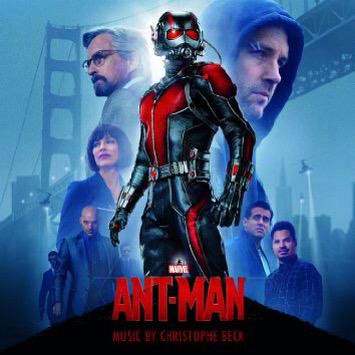
Beck’s swaggering, animated music deftly combines tropes
from superhero scores and heist scores to pleasing effect. The odd-metered
rhythm of the main theme provides the jazzy heist element (even more pronounced
in the surf-guitar cue “Tales to Astonish!”) while the actual melody furnishes
the requisite brassy heroism. “Scott Surfs on Ants, “Into the Hornet’s Nest,”
“Flight of the Bumblebee,” and “Ants on a Train” offer the best moments of
snazzy action while “Small Sacrifice” plays the main theme in a warmhearted
guise. The similarly warm theme for the Wasp balances all the stylish licks,
though it too plays in action mode in “Your Mom Died a Hero.” “First Mission”
features a grin-inducing cameo of Alan Silvestri’s Avengers theme and even more
pleasantly surprising statements of Henry Jackman’s Falcon motif from Captain
America: The Winter Soldier. Such respectful references to other Marvel scores
alongside the lively heist elements make for an attractive score, even if it
ultimately fails to reach the raw entertainment value of Alan Silvestri, Brain Tyler,
and Patrick Doyle’s contributions to the Marvel Cinematic Universe.
11. Call of Duty:
Black Ops 3 (Jack Wall)


Jack Wall’s scores for Myst III and IV were the first game
scores I loved, so I always look forward to any new work of his. Wall’s
electronics-heavy, high-octane music here is, on the surface, the polar
opposite of his lush, lyrical work on the Myst games. Indeed, cues such as
“Chasing Secrets,” “Cloud Mountain,” and “P.A.W.W.S” bristle with synthesized
momentum and power anthems; “Ramses Station” almost sounds like something you’d
hear on a dance floor. (No, not a ballroom one, though someone should try it
and see what happens). However, “Prologue/Black Ops” and “I Live (Orchestral
Version)” feature the explosive, dramatic mixed choir writing that were a
staple of his Myst scores, with “Ego Vivo” showcasing the voices in a more
liturgical mode. “Liberty Road” surges with triumphant orchestral action,
complete with flute and brass flourishes, excited strings, and a stirring
melody that Basil Poledouris would be proud to call his own. Several
tongue-in-cheek jazz, blues, country, swing, and Caribbean songs (for the
game’s zombie mode) are delightful bonuses. More entertaining to Wall’s work
for Black Ops 2, this score impresses with its mix of propulsive action and robust
melody.
Read Part 3 here.
Read Part 3 here.
