Showing posts with label Thomas Newman. Show all posts

Friday, January 1, 2016

Overview of 2015 Scores Part 2 of 3

Read Part 1 here.

20. The Good Dinosaur (Mychael and Jeff Danna)


Although the Danna Brothers’ Pixar score ranks behind those from Michael Giacchino and Thomas Newman as well as Randy Newman’s better efforts, it still aptly accentuates the breathtaking landscapes and straightforward relationships of the film. While the quantity of themes is impressive—the score features tunes for Arlo, Arlo’s home, Arlo’s family, Spot, and the T-Rexes—many of them sound just a little too similar.  The family theme, first heard in “Make Your Mark,” imparts nobility with its reverent chords, while “Run with the Herd” features galloping statements of the T-Rex-theme, the home theme, and Arlo’s theme. The Dannas’ characteristic use of exotic instrumental colors adds zest to the harmonically pleasing tunes, even if the effect fails to reach the admittedly lofty heights that Thomas Newman periodically reaches using similar musical ingredients. Perhaps the score’s only crime is not being as spectacular or memorable as other similar scores; it’s certainly pleasant with a well-structured dramatic arc.
(The Good Dinosaur Film Review)

19. Disneynature: Monkey Kingdom (Harry Gregson-Williams)


Gregson-Williams in electronic thriller mode is hit (Spy Game) or miss (The Number 23), but his orchestral scores almost always evince the composer’s command of melody and color. Exotic, ethereal voices and frisky, frolicsome rhythms abound in this score—sometimes in the same cue (“A Magical Kingdom”). “Maya” introduces a winsome little tune on pan flute—amidst all of the Tony Scott scores, one can forget that HGW is so good at writing these softer, appealing themes. “Top of the Trees” starts a pleasant groove—the delicate flute flourishes are a particularly nice touch. There’s an unexpected but lovely waltz in “The Lily Pond,” while “Termites” and “Retaking the Rock” boast lush strings fit for long shots of some natural vista. The latter cue features a touch of action as well, though it’s not top-tier Gregson-Williams material. As the adjectives in this long-winded paragraph reveal, this is a feel-good score, but it doesn’t have any truly spectacular moments or strong melodies.

18. Bridge of Spies (Thomas Newman)


Faced with the unenviable position of filling in for John Williams, Thomas Newman more than acquitted himself with his dignified music for this lauded Spielberg film. While Newman doesn’t abandon most of the elements that constitute his musical voice—the vivid instrumentation, prickly rhythmic ostinatos, and passages of tranquil harmonic bliss—he molds these elements into a more classically dramatic approach in the best Williams tradition. Resonant Russian choral tunes and a sincere, almost ballad-like main theme form the staunch foundation for the score, culminating in the impressive trifecta of “Glienicke Bridge,” “Homecoming,” and “End Credits” (which also make up more than half of the score’s running time). The first cue in this trio offers a master class on how to steadily build suspense without relying on dull drones or humdrum percussion patterns, the second explores heartfelt Americana, and the end credits showcase Newman’s invigorating choral writing. The first half of the score remains rather restrained, but I suppose that’s only reflecting the nature of the film itself.

17. The Hunt (Steven Price)


Although I wasn’t the biggest fan or Price’s Gravity, he did establish a distinct voice. The Hunt takes the most appealing aspects of Price’s musical style and spreads them out over 2.5 hours of mostly standalone cues, each one aurally portraying different species or aspects of the natural kingdom. Price starts the album with the best cue right off the bat—“A Game of Strategy” features an energizing anthem at once lyrical and heroic, reminiscent of Gravity’s penultimate cue. Price’s signature electronic manipulations of the orchestra don’t grate as they did in Gravity, but instead galvanize the theme, the sounds meshing with the counters of the melody organically. “The Blue Whale” is another highlight, orchestra and choir moving from ethereal wonder to almost transcendent majesty; string patterns play off each other, adding to the music’s kinetic energy. However, aside from five or six other cues, much of the rest of the lengthy score, while competent, fails to approach the stirring vibrancy of these two highlights.

16. Fifty Shades of Grey (Danny Elfman)


Given the movie’s sensationally lurid subject matter, Elfman wisely decided not to get too kinky with the music and risk camping up the images. (Or maybe they were still campy; I’m certainly not about to watch the film to find out.) A more lush variation on his recent documentary scores, the score relies on patterns, textures, and motifs rather than on overt, hummable themes. “Shades of Grey” sets the tone with bubbling electronics, sighing flute, and Elfman’s characteristically skittering strings. “The Red Room” finds Elfman getting a little funky with the electronics, recalling his music for Dead Presidents and the main titles for To Die For. Electric guitar creates an atmosphere of slowly simmering preparation and release in “Ana and Christian” (similar to the finale of The Kingdom), while voices denote sensual ecstasy in “Counting to Six” (and reaching ironically angelic heights in the non-Elfman composed “Bliss”). Elfman threads the conclusive “Variations on a Shade” (the best track) with an almost pop-ish beat on drum kit and electronics, orchestra churning under aspiring parallel notes from violins and bass guitar. The lack of a strong melody is a bit of a shame, but Elfman, as is his wont, still creates appealing music with just a touch (in this case) of cheekiness.

15. Jurassic World (Michael Giacchino)


Although this score shows that Giacchino isn’t quite John Williams’s successor, it does offer further proof that he is one of the most talented composers working today. After a welcome arrangement of Williams’s fantastic Jurassic Park theme (“Welcome to Jurassic World”), Giacchino mostly sticks to his own material, with snatches of Williams’s “island” fanfare and even the Lost World theme adding a kick to the proceedings. Giacchino shrewdly writes his new themes so they reflect the tone of Williams’s themes. The Indominus Rex theme’s low horns echo the ominous cast of the Velociraptor theme; the delicate family theme recalls the sparkling, childlike lullaby of “Remembering Petticoat Lane;” and the resplendent Jurassic World melody effortlessly flows into Williams’s Jurassic Park theme in “Nine to Survival Job.” However, it’s best not to compare the score to Williams’s near-peerless original as you’ll admittedly come away disappointed. Giacchino’s action material isn’t quite up to his usual standards, relying more on staid repetition of short musical fragments. Despite this minor reservation, choice moments, such as the brutal choral chanting in “Our Rex Is Bigger Than Yours” inject ample thrills, while Giacchino applies and develops his new themes—the arrogant, militaristic melody for InGen is particularly admirable—with remarkable aplomb.

14. The Hunger Games: Mockingjay Part 2 (James Newton Howard)


From the first to the third entry in Cookie Monster’s favorite franchise, James Newton Howard’s scores have gotten better, even if they haven’t quite reached the apex of his capabilities. The final entry continues the trend by being slightly better than its immediate predecessor, featuring the most sustained, thrilling, and rich action cues in the series. It’s not all blood and thunder, with “Your Favorite Color Is Green” developing a folk melody into a liturgical hymn and a spoiler-titled track pushing a solo female vocal into near-operatic peaks. The two “Attack” cues (Sewer and Rebels) surge with dynamic syncopated ostinatos, sumptuous fanfares worthy of the composer’s Disney scores, and staccato choir outbursts—a far cry from the stripped down action cues in the first Hunger Games. To cap off the series, Howard sends off Rue’s heartbreaking theme with a gorgeous threnody followed by cascading waves of strings joined by triumphant brass and choir. The score is still far from Howard’s best, but he did manage to gradually introduce the lush compositional mannerisms that made so many (like me) fall in love with his music.

13. Pixels (Henry Jackman)


While not as John Williams-esque as Jackman proclaimed in various interviews, Pixels still mostly eschews the 8-bit video arcade palette the composer had so adroitly employed in Wreck-It Ralph in favor of florid orchestral and choral gestures. The score’s primary weakness is its relatively anonymous theme. First heard in “The Arcaders,” the melody’s ascending shape, strumming electric guitar backing, and triumphant, brassy orchestration—all reminiscent of the superior Big Hero 6 theme—do mark it as an unmistakably Jackman composition. The score is all about the action cues, and the composer provides all the bells and whistles (though there aren’t many actual bells and whistles, if any). “Call to Cavalry” marches ahead with forthright determination towards a descending rendition of the main theme amidst swirling strings, while portentous choir threads its way through “Centipede,” “Shoot ‘Em Up,” and “Mothership.” In the climactic “Roll Out the Barrels,” Jackman deftly weaves various harmonic variations of the theme throughout the action, ending with a noble brass version that sounds like the song “City of Lights” from The Brave Little Toaster. Finally, Jackman concedes to the film’s video game villains with the addictive, all too brief “Arcaders ’82,” even if does contain a healthy dose of modern electronics alongside the retro samples. With a longer, more sophisticated them and a better dramatic arc, this could have been one of the scores of the year; as it is, it’s still a lively, energetic composition.

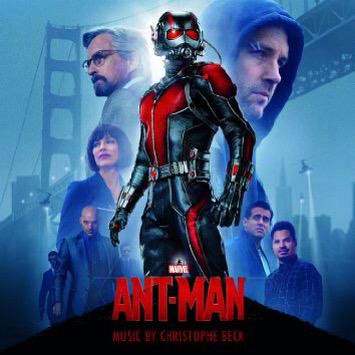
12. Ant-Man (Christophe Beck)


Beck’s swaggering, animated music deftly combines tropes from superhero scores and heist scores to pleasing effect. The odd-metered rhythm of the main theme provides the jazzy heist element (even more pronounced in the surf-guitar cue “Tales to Astonish!”) while the actual melody furnishes the requisite brassy heroism. “Scott Surfs on Ants, “Into the Hornet’s Nest,” “Flight of the Bumblebee,” and “Ants on a Train” offer the best moments of snazzy action while “Small Sacrifice” plays the main theme in a warmhearted guise. The similarly warm theme for the Wasp balances all the stylish licks, though it too plays in action mode in “Your Mom Died a Hero.” “First Mission” features a grin-inducing cameo of Alan Silvestri’s Avengers theme and even more pleasantly surprising statements of Henry Jackman’s Falcon motif from Captain America: The Winter Soldier. Such respectful references to other Marvel scores alongside the lively heist elements make for an attractive score, even if it ultimately fails to reach the raw entertainment value of Alan Silvestri, Brain Tyler, and Patrick Doyle’s contributions to the Marvel Cinematic Universe.

11. Call of Duty: Black Ops 3 (Jack Wall)


Jack Wall’s scores for Myst III and IV were the first game scores I loved, so I always look forward to any new work of his. Wall’s electronics-heavy, high-octane music here is, on the surface, the polar opposite of his lush, lyrical work on the Myst games. Indeed, cues such as “Chasing Secrets,” “Cloud Mountain,” and “P.A.W.W.S” bristle with synthesized momentum and power anthems; “Ramses Station” almost sounds like something you’d hear on a dance floor. (No, not a ballroom one, though someone should try it and see what happens). However, “Prologue/Black Ops” and “I Live (Orchestral Version)” feature the explosive, dramatic mixed choir writing that were a staple of his Myst scores, with “Ego Vivo” showcasing the voices in a more liturgical mode. “Liberty Road” surges with triumphant orchestral action, complete with flute and brass flourishes, excited strings, and a stirring melody that Basil Poledouris would be proud to call his own. Several tongue-in-cheek jazz, blues, country, swing, and Caribbean songs (for the game’s zombie mode) are delightful bonuses. More entertaining to Wall’s work for Black Ops 2, this score impresses with its mix of propulsive action and robust melody.

Read Part 3 here.

Tuesday, December 29, 2015

Overview of 2015 Scores Part 1 of 3

I seem to be consistently buying 27-29 new soundtracks a year since I started these sublimely prosaic “Year in Review” posts. Although I wouldn’t call any of them duds, I can’t really say there were any jaw-dropping masterpieces either. Film-score wise, I’ll remember 2015 as the year I discovered Miklós Rózsa and Naoki Sato; nothing I’ve heard this year exhilarated me more than the scores to, say, Ben-Hur or Space Battleship Yamato.

2015 saw Thomas Newman tucking a second Bond score and a first Spielberg score under his belt; neither was particularly outstanding, but they still evinced Newman’s compositional and dramatic dexterity; his Oscar is long overdue. Brian Tyler also took on two high-profile scores, one of which featured surprise contributions from Danny Elfman. John Powell also provided a “surprise” replacement score, while his old compadre Harry Gregson-Williams proved that he’s still force to be reckoned with. And while one force awakened in December, the year belonged to Michael Giacchino, who wrote four scores ranging from very good to excellent.

2015 did have its fair share of lamentable scores, but I elected not to buy them on CD or digital; hearing them in the film was enough. Chappie by Hans Zimmer turned out to be a bunch of electronic noise—certainly a disappointment following his work on Interstellar the previous year. I literally don’t remember if there was any original score in Clouds of Sils Maria, but I do remember some classical pieces, Pachelbel’s Canon in D being the foremost. Mission: Impossible Rogue Nation by Joe Kraemer wasn’t bad, but it didn’t grab me, especially after I read so many rave reviews. Finally, Mad Max: Fury Road by Tom Holkenborg had perhaps five minutes of music that made me perk up my non-elfin ears a bit, but the rest failed to rise above standard RC monotony.

Finally, I’d be remiss if I didn’t mention James Horner. His score for Southpaw featured a sadly nondescript, droning score. On a happier note, I did discover Cocoon, one of his masterpieces. I was never the biggest fan of Horner’s music, despite really liking a few of his scores. After his untimely death, I re-evaluated some of his works—A Beautiful Mind was as dull as ever besides the sublime opening 90 seconds of the first track, but I’ve gained more appreciation for Glory and The Perfect Storm. His best works did manifest his superb dramatic instincts, and it’s fitting that La-La Land Records capped off this year with an expanded release of Braveheart—one testament of many to the remarkable gifts of a man taken from us all too soon.

I know there are still oodles of scores that I haven’t listened to, but at this point, it will take me a while before I can get to anything new. For the time being, here is my ranking of 2015’s scores:

28. He Named Me Malala (Thomas Newman)


Newman sat firmly in his comfort zone for this documentary, and the results aren’t quite as consistently entertaining as Saving Mr. Banks, his comfort zone score from last year. Still, tracks like “A Pashtun Story” and “Which Camera Now?” offer generous helpings of Newman’s appealing, sequence-based bundles of exotic color, while “School V. Celebrity” bristles with optimistic enthusiasm entirely befitting the young girl who serves as the documentary’s subject. “The Women” imparts tranquility through an almost Renaissance-styled tune, while “66 Million Girls” features poignant piano and female vocals and touching orchestral swells. Outside those cues, though, the score remains low-key, as many tracks pass by without making much of an impression. If Newman writes another comfort zone score next year, let’s hope that its average tracks match the quality of this score’s highlight tracks.

27. Furious 7 (Brian Tyler)


If you want a score dripping with testosterone-fueled adrenaline, you can count on Brian Tyler to deliver—all with a winning smile and painstakingly styled hair. Tyler’s score for this film is a step back from his entertaining tunes to Fast Five, though still better than what any other composer has brought to this series so far. Electronics play a bigger role here—I’d say they were dubstep-influenced, but what do I know? “A Completely Insane Plan,” “Mountain Hijack,” “Party Crashers,” and “Hobbs Is the Cavalry” offer spurts of Tyler’s action, but none prove as thrilling as the extended “Train Heist” or “Vault Heist” from Fast Five—I suspect much of 7’s action has been cut from the album. The over-the-top (if brief) stentorian, doomsday choral statements in “Battle of the Titans” do offer campy entertainment, while the statements of the simple yet energizing Fast Five theme form a satisfying link to the past.

26. Goosebumps (Danny Elfman)


Danny Elfman has always been one of my favorite composers, and many film score fans have hailed this score as a throwback to Elfman’s fun, Gothic days—how’s that for an oxymoron? Indeed, fleeting phrases call to mind bits like Sleepy Hollow, the Mayor’s theme from Nightmare Before Christmas, Catwoman’s and Penguin’s themes from Batman Returns, and Elfman’s trademark, twisted lullaby-celeste melodies. Yet this score didn’t really cohere for me. The title track is a clear highlight, with the sinuous main theme snaking its way through the orchestra, complete with theremin and voices. A surprisingly tender theme, first heard in “Ferris Wheel,” developed in cues such as “Hannah’s Back” and “Farewell,” rounds out the thematic palette. Neither theme is among Elfman’s best, though, so despite the expected dexterity of Elfman’s writing, this score will have to settle for a lesser position in the composer’s impressive catalog.

25. SPECTRE (Thomas Newman)


I enjoyed Newman’s score for Skyfall, though I’d still rate it below most of David Arnold’s Bond entries. SPECTRE is less consistent than Skyfall, dragged down by a fair share of droning tracks. Newman derives much of the action material from Skyfall’s pre-credit sequence and, during the climax, a throbbing, 13-note electric guitar ostinato from “The Moors.” Still, Newman adds a dash of vibrancy to SPECTRE with his use of voices, backing the orchestra in “The Eternal City” before bursting forth magnificently in the premier action cue “Backfire.” “Snow Plane,” “Safe House,” and “Detonation” offer escalating action enhancing the sense of jeopardy (though of course we know that Bond won’t die) while “Westminster Bridge” features a ripping statement of the Bond theme for trumpets in such a high register that it would make David Arnold grin. Though Newman uses the choir sparingly, the choral work really does provide most of the score’s interest; as Angels in America proves, Newman + choir = brilliance.

24. The End of the Tour (Danny Elfman)


Elfman in subdued drama mode is always a nice change of pace, even if it seldom results in show-stopping scores. Mallet percussion instruments (including marimba) serve as the metallic spine of this score. Most of the tracks consist of drawn-out notes meditating on whatever the film’s characters are ruminating on, I suppose. But in tracks such as “Talk to Jan” and “Minneapolis,” the percolating percussion creates an atmosphere at once amiable, kinetic, and subtly melancholy. “Mall of America” evokes a more carefree happiness, inviting the listener to cast aside their cares for its 48 second running time. The chimes of tubular bells lend “Going Sour” a more reverent tint, though buzzing electronics keep the tone from becoming liturgical. Though Elfman displays inventiveness with the instrumentation, he doesn’t provide the score with a melodic hook or profound emotion. However, his track record proves that he probably did provide what was best for the film.

Lacking a strong central theme, this score instead relies on nimble lines on solo instruments and the charm of its variegated set pieces. “Young Philippe” introduces a delightful waltz theme that would make a worthy dance partner with the effervescently confident main character, but the theme sadly doesn’t recur that often—in fact, it reaches its lush apex in the very next cue, “The Towers of Notre Dame,” and only appears in fragmented form in the last track. (I’m too lazy to type out its full name, which is worthy of James Horner.) “We Have a Problem” showcases Silvestri’s always-exciting rhythmic action, but quiet, anticipatory tension makes up the bulk of the score. Synth choir (mostly female, except for in the cue “I Feel Thankful”) aptly reflects the ethereal, almost otherworldly feeling of walking thousands of feet in the air, but a strong main theme to reflect Petit’s physical and emotional journey would’ve helped make this score even better

22. San Andreas (Andrew Lockington)


Andrew Lockington writes accomplished, adventurous music that has pleased many, yet I find his music lacks that ineffable enchantment that makes me really love a particular score. San Andreas finds Lockington writing in a more modern style than he has previously, complete with pounding drums, low string ostinatos, and Inception foghorns. The “Main Theme” introduces an elegiac boys’ choir, and a lyrical sense of melody infuses much of the action cues with anthemic triumph. In some ways, this score represents how I wish Hans Zimmer’s action style had developed after 1998. But while “Extinction” and “Resuscitation” thrust the choir to heights of glory (OK, I’m exaggerating a bit), the themes themselves are nebulous; even after listening to the bookend tracks several times, I have trouble picking out the themes in the body of the score. Some have compared Lockington to David Arnold; while I won’t get into that here, I will say that Lockington’s scores always tend to peter out, while Arnold liked to end his adventure scores with spectacularly overblown apotheoses, complete with blazing orchestral fanfares and rapturous choral hosannas.

21. Victor Frankenstein (Craig Armstrong)


Although Armstrong fleshes out the film’s characters with Gothic music (and, considering Mary Shelley’s original book, the word “Gothic” is actually appropriate), he focuses more on brooding darkness than on thrilling terror—the opposite of Patrick Doyle’s approach to Kenneth Branagh’s Frankenstein film. In “Dark Red Theme 2,” lush strings and sympathetic choir pour out a melody of resigned tragedy. “Igor Transformed” boasts a childlike, almost heavenly rendition of the theme, demonstrating the melody’s versatility. When the action does come in “Gordon’s Escape,” “Turpin’s Theme,” “Reunited,” and “Finale,” brass snarls, arpeggios swirl, voices chant, and strings rampage alongside the onscreen monster(s). Particularly impressive is how Armstrong wrings dark tragedy, usually the domain of low strings and brass, out of high strings and female voices. Armstrong doesn’t use the themes as much as I would’ve liked, and while the score does well portraying the tragic, it doesn’t quite become truly heart-rending. Still, I was mostly impressed by this score from an unexpected quarter.

Read Part 2 here.

Read Part 3 here.

Tuesday, January 28, 2014

Overview of 2013 Scores Part 3 of 3

For reference, I don’t think there’s actually that much difference in quality among scores #10-#2. They’re all within a hair of being superb.

10. Saving Mr. Banks (Thomas Newman)
The score for Saving Mr. Banks is Thomas Newman squarely in his comfort zone, but what a comfort zone it is. He combines his always-unique and distinctive instrumentation with lush orchestral themes, recalling some of his best scores: Shawshank Redemption, Meet Joe Black, Lemony Snickett’s A Series of Unfortunate Events, and Angels in America. While not quite as superlative as these stellar works, this score is still ripe with signature Newman moments. “Travers Goff” opens the score with an expansive string melody, but Newman’s characteristically driving piano soon enters. This melody is reprised in “Beverly Hills Hotel” and expanded upon in “Ginty My Love.” “Walking Bus” contains colorful instrumentation, recalling A Series of Unfortunate Events in particular, while “Jollification” takes this quirkiness further, becoming American Beauty-esque. “Leisurely Stroll” brings wonderful string swells to the forefront, reminiscent of Finding Nemo. Repeated piano notes propel “Whiskey” and Newman twists his style into a quasi-jazz cue for “Mrs. P.L. Travers.”  “Mr. Disney” is Newman’s idiosyncratic take on a fanfare, with a more majestic take in “The Magic Kingdom.” Finally, “Saving Mr. Banks (End Title)” closes the score with an eloquent orchestral melody. The score is not quite the perfection Newman has achieved with other scores, but it’s close.

9. Oz: The Great and Powerful (Danny Elfman)
Sure, the main theme bears an uncanny resemblance to “O Canada!” and the witches’ theme is straight out of Elfman’s tried-and-true toolbox. But the composer still manages to concoct a delicious fantasy score with indelible moments, from the majestic “Main Titles” and the dynamic “Preparation Montage” (Elfman is ever the master of the montage) to the wondrous “Bubble Voyage” and the heartbreakingly tender “China Town.” The playful composer even contributes a wacky “Munchkin Welcome Song,” recalling a similarly titled opus from Charlie and the Chocolate Factory. Unfortunately, much of the final battle music is not on the CD. But the frenetic, almost impossibly frenzied final 45 seconds of the penultimate track, “Time for Gifts,” is pure film music pleasure of the highest order, almost like a condensed version of the “Main Titles” from Charlie and the Chocolate Factory (sans electronics). I for one am glad that Elfman and director Sam Raimi made up (though Christopher Young would probably have done a good job as well). Coming up for Elfman (pun very much intended) is Fifty Shades of Grey, which should be…interesting.

8. Iron Man 3 (Brian Tyler)
I wrote a bit about the score to Iron Man 3 here; more than half a year after that post, I can now say that Tyler wrote probably my favorite theme of the year for this film. It’s an unabashedly muscular, heroic, robust anthem, the kind that Man of Steel should have had (in terms of memorability, effectiveness, and grandeur, not necessarily in terms of musical style). Plus, it’s pliable enough to play morosely in “Isolation” and funky in the rocking throwback end title track “Can You Dig It?” Much of the score before the lengthy finale is actually rather subdued and doesn’t use the main theme much. That’s primarily why this score isn’t placed higher. But once the climax kicks in (comprising the tracks “Dive Bombers,” “Battle Finale,” “Stark,” “Heat and Iron,” and “Hot Pepper”), the score finally comes into its own as a massive action opus. One of my favorite moments is the build-up from 1:20-1:27 in “Stark.” Like the entire score, it’s simple, yet stunningly compelling.

7. The Book Thief (John Williams)
The Book Thief was a surprise assignment for the world’s reigning maestro, but certainly a welcome one. Far from Star Wars and Indiana Jones in nearly every aspect but quality, the score still retains Williams’s peerless compositional voice. While he doesn’t embark on any new avenues, his painstakingly precise writing is as sublime as ever. Choice moments are legion: The tender introduction of the main theme in “One Small Fact” preceding a surging restatement of the same, the rich string writing in “The Train Station,” the emotionally overwhelming simplicity of the oboe tune in “Max and Liesel,” and the effortlessly flowing recapitulation of the theme in “Learning to Read.” By the time the “Finale” and the suite “The Book Thief” roll around, Williams has more than proven his mastery—as if he needed to at this point. Even more than Lincoln, however, this score requires attention and patience to appreciate the subtleties of its craft. Less engaging passages do exist, and there isn’t quite the sense of freshness of War Horse or The Adventures of Tintin, and these reasons are why this score isn’t higher up on my list. But John Williams is still the man.

6. The Hobbit: The Desolation of Smaug (Howard Shore)
Howard Shore’s middle score to the most drawn-out trilogy in history improves upon its predecessor, but still lags behind the scores for The Lord of the Rings. The main problem is the shortness, obscurity, and relative un-memorability of Shore’s new themes. They certainly aren’t lacking in quantity: we have several Bilbo themes, a Gandalf the Grey theme, a handful of Erebor/Thorin themes, themes for Mirkwood, the Wood Elves, Tauriel, Bard, Laketown, Smaug, and more. The jaunty tune for Laketown is neat, and I like the mesmerizing instrumentation and percussion of Smaug’s primary theme (apparently he has more than one theme), even if I can’t recall the actual melody. My two favorite themes are the ones having to do with Tauriel, the female version of Link for those uninitiated with Peter Jackson’s version of Middle-Earth. Her fluttering theme works great as an action fanfare in “The Forest River,” a track that proves that Shore has improved his action writing since The Lord of the Rings. The theme for her relationship with Kili (Aragorn Jr.) is simple yet enchanting. Time will tell if There and Back Again will allow Shore to return to the heights of the Original Trilogy. (Mr. Williams welcomes you to the club, Mr. Shore.)

5. Thor: The Dark World (Brian Tyler)
Brian Tyler’s main theme for the second Thor film isn’t as original or good, frankly, as Patrick Doyle’s themes for the original or Tyler’s own theme for Iron Man 3. But somehow, Tyler uses this basic theme to craft the most entertaining, solid start-to-finish score for a Marvel Studios film. The main theme is an almost overblown, epic fantasy tune complete with furiously chanting choir and simple harmonies. Yet Tyler includes orchestral flourishes and clever motifs to keep the tune from becoming yet another Remote Control remnant. The theme actually has three distinct parts; the second part is often used as a love theme and the third (girded by a gliding electronic tone) is used for traveling to Asgard and especially heroic moments. “Into Eternity” includes a heartfelt, tragic rendition of the first part of the theme, and “Asgard” features yet another theme that isn’t really used in the film itself (it plays in the credits right after the first bonus scene). Loki’s sinuous, serpentine theme underscores his obviously deceitful nature, but also plays in a heroic action setting in “Convergence.” And Tyler’s incorporation of Alan Silvestri’s Captain America theme in “An Unlikely Alliance” makes for one of the most delightful film music moments of the year. The entire score almost never lets up, enthralling fantasy-action moments filling it up to the brim. Now, if only Marvel could get Brian Tyler to score Guardians of the Galaxy instead of that other Tyler….

4. Planes (Mark Mancina)
Mark Mancina hadn’t scored a major film since “Imagine That” in 2009, and Planes marked a very welcome return. The film allows Mancina to write plenty of action, an area where he has always excelled. Cues such as “Start Your Engines,” “Running on Fumes,” “Get Above the Storm,” and “Skipper to the Rescue” certainly reveal Mancina’s musical history as one of the earliest of Hans Zimmer’s protégés. But his command of the orchestra is stronger than many of those from the Zimmer school, and the music is slightly reminiscent of Mancina’s rollicking action cues for Tarzan. “Dusty & Ishani” uses Indian instrumentation that is almost certainly not authentic, but is nevertheless extremely attractive and well written. The theme for Skipper is a noble anthem that Mancina transforms into an outright chorale in the moving “Skipper’s Theme (Volo Pro Veritas).” However, it is the stirring main theme that serves as the score’s highlight; Mancina can add another notch to his belt for great themes. The noble, soaring trumpet melody has five phrases; the third and fourth are my favorite, as they seem to convey a sense of yearning as-yet unrequited. The drums and guitar add an appropriate sense of energy without going over the top. Best heard in “Dusty Soars,” “First Place,” and “Planes,” this is my second favorite theme of the year (behind Iron Man 3).

3. Escape from Tomorrow (Abel Korzeniowski)
There are two weaknesses to this score: first, it’s too short at 20 minutes. Second, two of the tracks consist of meandering electronic textures. But Korzeniowski composed 15 minutes of singular elegance for this offbeat film about a family’s breakdown at the Disney parks. And indeed, the music would be perfect as background music for the parks themselves. The end of “Fantasy Girl” has a stately, brassy optimism characteristic of the music played at Epcot. “Gates of Tomorrow” and the two “Magic Kingdom” tracks feature gorgeous themes while “The Grand Finale” closes the score with resplendent, soaring flourishes. “Fireworks” is the kind of crazy track I like. (Yes, there is crazy music I don’t like; see “Martian Mambo” from John Powell’s Mars Needs Moms.) It opens with a complicated string line before expanding into a portentous action track, complete with chimes.  Then, an unsettling children’s choir enters, keening an eerie five-note ostinato. Speaking of children’s choir, they return for a final song, “Imaginate!” lampooning “It’s A Small World” with subtly twisted lyrics and malignantly jaunty woodblock accompaniment. The composer, choir director, or conductor even manages to make the kids sing in a slightly demented tone. One only wishes that Korzeniowski had been allowed to develop his musical ideas further.

2. Kick-Ass 2 (Henry Jackman and Matthew Margeson)
When I saw this movie in the theaters and the Kick-Ass theme started playing under the studio logos, I grinned inside (I admit to being on the phlegmatic side outwardly). Henry Jackman’s reaching, heroic melody for the wannabe superhero has become one of my favorite themes, and the best parts of this sequel score use this theme. Margeson appears to have actually written most of this score, and I honestly think his new themes for Hit-Girl and the Motherf*cker (the former Red Mist) are just okay. At least he keeps them both in same musical ballpark as the themes from the first film; the first two notes of Hit-Girl’s theme are the same as the first two of Big Daddy’s, and the Motherf*cker’s theme is backed by an electric guitar line that is also a more simplified version of Big Daddy’s theme. “Mindy’s First Date” display’s Hit-Girl’s theme in its emotional guise, while “Dave’s Field Test” uses it heroically. “Cemetery Attack/Hit-Girl is Back” and “Warehouse Showdown” are the best action tracks, often using a persistent electronic beat under the Kick-Ass and Motherf*cker themes. “Hit-Girl’s Farewell” recalls the sublime blend of grandeur, triumph, and coolness of “Flying Home” from the first film, but the orchestral arrangement sounds thinner. “Justice Forever” is a highlight (it’s the track that plays under the Blu-ray/DVD menu), electric guitar and electronics building to a brassy fanfare of the Kick-Ass theme, moving on to a full orchestral statement of the theme that precedes an eruption of drums and a stirring string line. “Main Titles,” which plays under the logos, starts out with a soft orchestral statement of the theme as a bass pulse grows and grows, becoming massive as more bubbling electronics enter and the theme transitions to synthesizer. It’s pure musical heaven. Another one of my favorite tracks is the sadly unused “Last Resort,” in which a gargantuan statement of the Kick-Ass theme starts on electric guitar before exploding into orchestra and choir as the theme ascends to its zenith. As a whole, this score is more cohesive than the original, but with fewer highlights. However, it’s still the most flat-out fun, consistently entertaining score I heard this year.

1. Romeo and Juliet* (Abel Korzeniowski)

Korzeniowski was a last-minute replacement for the famed James Horner on this score. But unlike the score for Ender’s Game (where Horner was replaced by Steve Jablonsky), the score for Romeo and Juliet likely exceeds what Horner would have done based on his recent track record. Korzeniowski’s simple themes are bolstered by exquisite orchestrations and opulent bursts of heavenly beauty. Although it is a close companion to the composer’s score for W.E. with its lush strings, piano, and semi-minimalistic writing, a sense of inevitable tragedy permeates the score and provides it with its own character. “Forbidden Love” starts with a tender build-up laden with anticipation before the celestial main theme pours out from the strings. The end of “First Kiss” is rapturous in its emotional intensity, while “A Thousand Times Good Night” explores the wondrous main theme further with piano lines that are both pounding and euphoric. Similarly masterful piano writing imbues “Juliet’s Dream” with romantic aching. “Fortune’s Fool” and “From Ancient Grudge” hint at the kind of furious action Korzeniowski excels at (and has sadly only really been able to explore in his score for Battle for Terra) while keeping within the score’s partially minimalistic idiom. The two “Crypt” cues are more subdued until the end, leading into the divine final cue, “Eternal Love.” Here, a solo female voice sings an elegy for the doomed lovers before leading into a final beatific statement of the main theme. Korzeniowski’s sumptuous score is a splendid achievement and my favorite score of the year; it just hits the spot for me.  In fact, while listening to it again for review purposes, I really fell in love with it even more and upgraded it to asterisk status (just below the absolute highest rating of two asterisks). While Korzeniowski excels at these romantic scores, I hope he will be allowed to explore more styles and genres.